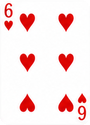
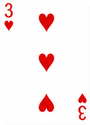
Low suited two-gapper
Six-Three Suited
63s is a two-gapper, not a connector. It is less connected than 53s and has lower straight coverage than 74s despite sharing the same two-gap shape with 74s. Its best preflop uses are selective late opens and priced big-blind defense, especially when stacks are deep enough to realize disguised draws.
How to play 63s by position and stack size
| Recommended action | UTG8-max | UTG18-max | LJ6-max | HJ6-max | CO6-max | BTN6-max | SB6-max |
|---|---|---|---|---|---|---|---|
| 100bb+ | Fold | Fold | Fold | Fold | Fold | Fold | Limp |
| 40-100bb | Fold | Fold | Fold | Fold | Fold | Fold | Limp |
| 27-40bb | Fold | Fold | Fold | Fold | Fold | Fold | Limp |
| 20-26bb | Fold | Fold | Fold | Fold | Fold | Fold | Limp |
| 16-19bb | Fold | Fold | Fold | Fold | Fold | Fold | Jam |
| 11-15bb | Fold | Fold | Fold | Fold | Fold | Fold | Jam |
| 7-10bb | Fold | Fold | Fold | Fold | Fold | Fold | Jam |
| 6bb- | Fold | Fold | Fold | Fold | Fold | Fold | Jam |
Open first in when the table is soft enough for fold equity to matter.
63s has little high-card removal and poor performance against continuing ranges.
Effective depth matters because many wins come from disguised straights and flushes. a late open with a favorable price.
Stack depth and fold equity, not suitedness alone, must justify the shove.
A single pair is often outkicked.
Strong against
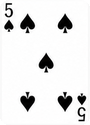
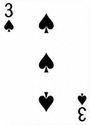
53s shares the Three but has the weaker kicker, making a dominated pair that can still pay 63s.
Weak against
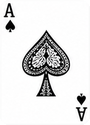
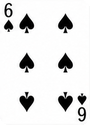 A6s
A6sA6s shares the Six with the better kicker, so 63s can make a costly second-best pair.
Flop classes
63s makes two pair with its hole cards. Use the board and ranges to choose between betting and checking, 63s is not automatically a stack-off.
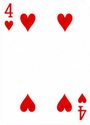
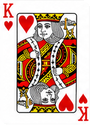
With 4-5 on the board, 63s has 3-4-5-6 and can complete a straight with a 2 or 7. This is an OESD, not a made straight.
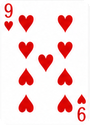
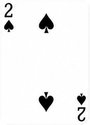
The single spade gives a backdoor flush draw, but the board supplies no immediate straight draw or pair.
Strategic notes
- Usually fold: Call only when the price, position, and effective stacks create enough implied value.
- 63s is not a connector. Do not give it the automatic straight-draw assumptions that apply to hands such as 54s.
- Look for connected middle-low boards: 63s needs specific ranks to form a real straight draw, many low flops give only backdoors.
- Treat one pair as bluff-catcher strength: Stronger sixes and overpairs often dominate it.
- Deep stacks help only with a price: Out of position, reverse implied odds can outweigh the value of hidden draws.