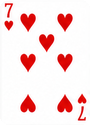
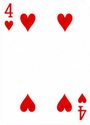
Low suited two-gapper
Seven-Four Suited
74s is a two-gapper with more high-card strength than 63s but the same basic straight spacing. It can flop a disguised straight on 5-6-8, an OESD on 5-6, or only a backdoor draw on many boards. Keep it to selected late opens and priced big-blind defense.
How to play 74s by position and stack size
| Recommended action | UTG8-max | UTG18-max | LJ6-max | HJ6-max | CO6-max | BTN6-max | SB6-max |
|---|---|---|---|---|---|---|---|
| 100bb+ | Fold | Fold | Fold | Fold | Fold | Fold | Limp |
| 40-100bb | Fold | Fold | Fold | Fold | Fold | Fold | Limp |
| 27-40bb | Fold | Fold | Fold | Fold | Fold | Fold | Limp |
| 20-26bb | Fold | Fold | Fold | Fold | Fold | Fold | Limp |
| 16-19bb | Fold | Fold | Fold | Fold | Fold | Fold | Jam |
| 11-15bb | Fold | Fold | Fold | Fold | Fold | Fold | Jam |
| 7-10bb | Fold | Fold | Fold | Fold | Fold | Fold | Jam |
| 6bb- | Fold | Fold | Fold | Fold | Fold | Fold | Jam |
Early-position opens expose 74s to stronger ranges and dominated pairs.
It is a poor default bluff because it blocks few strong continues.
Deep stacks improve the value of disguised straights, but position still matters.
Do not apply a universal shove rule.
74s often makes weak pairs.
Strong against
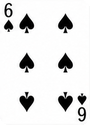
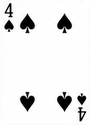
64s shares the Four but has the weaker kicker, making a dominated pair that can still pay 74s.
Weak against
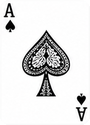
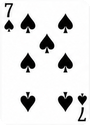 A7s
A7sA7s shares the Seven with the better kicker, so 74s can make a costly second-best pair.
Flop classes
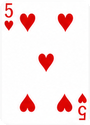
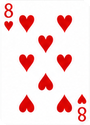
74s makes the 4-5-6-7-8 straight. It is a made straight, though higher straights and flushes can still matter.
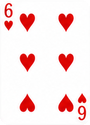
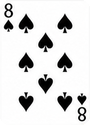
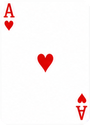
The 4-6-7-8 sequence needs a 5, so this is a gutshot rather than an OESD.
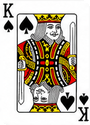
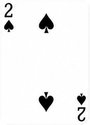
The 7 pairs, and the one spade on the board gives a backdoor flush draw. Do not overvalue the pair.
Strategic notes
- Usually fold: Continue only with a strong price and enough effective depth to realize a disguised draw.
- Do not treat a two-gapper as a connector. 74s needs the right ranks on the flop before it has a real straight draw.
- Prioritize made straights and strong draws: A pair of sevens or fours is often a thin bluff-catcher.
- Track the exact straight shape: Some boards give a gutshot, some an OESD, and some no immediate draw.
- Reduce pot size out of position: Deep pots with dominated pairs create difficult turn and river decisions.