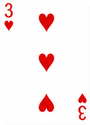
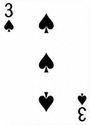
Small pair
Pocket Threes
33 is a set-mining hand with slightly more showdown value than 22. It is an underpair on most flops, an overpair only on boards below Three, and it needs position, depth, and a good price before continuing against pressure.
How to play 33 by position and stack size
| Recommended action | UTG8-max | UTG18-max | LJ6-max | HJ6-max | CO6-max | BTN6-max | SB6-max |
|---|---|---|---|---|---|---|---|
| 100bb+ | Fold | Fold | Open | Open | Open | Open | Limp |
| 40-100bb | Fold | Fold | Open | Open | Open | Open | Limp |
| 27-40bb | Fold | Fold | Open | Open | Open | Open | Limp |
| 20-26bb | Fold | Fold | Open | Open | Open | Jam | Limp |
| 16-19bb | Fold | Fold | Fold | Fold | Jam | Jam | Jam |
| 11-15bb | Fold | Fold | Jam | Jam | Jam | Jam | Jam |
| 7-10bb | Fold | Jam | Jam | Jam | Jam | Jam | Jam |
| 6bb- | Jam | Jam | Jam | Jam | Jam | Jam | Jam |
33 can open more often when a set can win a meaningful pot and the blinds defend too wide.
33 is not a standard value 3-bet and should not inflate a deep pot without a range-based reason.
The price must account for making a set only about once in eight flops. 25 effective big blinds or more.
A shove depends on position, antes, and ranges, not on the pair alone.
A small pair cannot rely on showdown value when overcards dominate the board.
Strong against
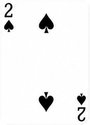
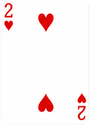
22 can set-mine and still pay a small value bet, while 33 keeps the starting-hand edge.
Weak against
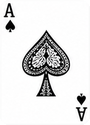
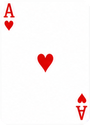 AA
AAAA is ahead of 33 preflop. 33 needs a set or a credible bluff-catching reason to continue against strong action.
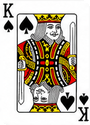
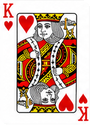 KK
KKKK is a higher pair that can value-bet while 33 remains a lower one-pair hand.
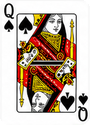
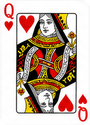 QQ
QQQQ is ahead of 33 before the flop, leaving 33 with a narrow path to a large pot.
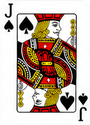
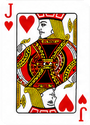 JJ
JJJJ is also higher than 33 and can continue for value against one-pair calls.
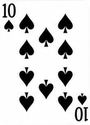
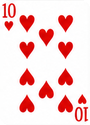 TT
TTTT is a higher pair that can keep 33 in the pot as a dominated lower pair.
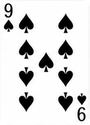
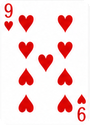 99
9999 is higher than 33 and can value-bet when the range keeps betting.
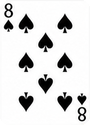
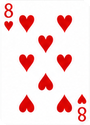 88
8888 can continue with a higher pair, while 33 mostly needs a set to win a large pot.
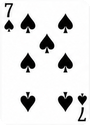
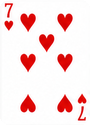 77
7777 is another higher pair that can target calls from 33.
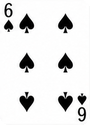
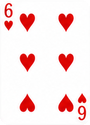 66
6666 is ahead of 33 preflop and can value-bet against a lower pair.
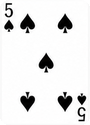
 55
5555 can keep 33 in the pot with a higher pair, so 33 needs a set or a precise bluff-catching read.
 44
4444 is the nearest higher pair and can extract value from 33 when it continues.
Flop classes
On 3♣ 9♦ K♥, 33 has flopped a set and can build value when worse hands and draws continue.
On T♠ 8♦ 2♣, 33 is below the board's highest cards and should prefer a controlled pot when facing resistance.
On 7♣ 5♦ 2♠, 33 is an underpair to two board cards with two usual outs to a set. Overcards remain a serious threat.
Strategic notes
- Call: Continue mainly in position when the sizing is small and effective depth gives set value.
- Fold: Fold against tight ranges, out of position, or when the stacks are too shallow for a profitable set mine.
- Jam: Use a shove only in a specific short-stack or tournament configuration.
- Fold: Usually fold because the range is concentrated in higher pairs and strong overcards.
- Call: Continue only with exceptional depth and price, 33 does not have enough standalone equity.
- Value line: A flopped set gives 33 a strong value hand, but flush and straight possibilities still shape the sizing.
- Control line: As an underpair, 33 has modest showdown value. Position matters more than a generic bet-or-fold rule.
- Common mistake: Do not call 33 a semi-bluff without a real draw, and do not assume every low board favors it.