Top pair
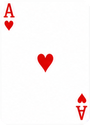
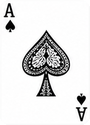
Pocket Aces
AA is the preflop favorite against every other starting hand, but one pair is not invulnerable after the flop. Build pots on dry boards and keep the pot smaller when straight, flush, or paired-board combinations become credible.
How to play AA by position and stack size
| Recommended action | UTG8-max | UTG18-max | LJ6-max | HJ6-max | CO6-max | BTN6-max | SB6-max |
|---|---|---|---|---|---|---|---|
| 100bb+ | Open | Open | Open | Open | Open | Open | Limp |
| 40-100bb | Open | Open | Open | Open | Open | Open | Open |
| 27-40bb | Open | Open | Open | Open | Open | Open | Open |
| 20-26bb | Open | Open | Open | Open | Open | Open | Limp |
| 16-19bb | Open | Open | Open | Open | Open | Open | Limp |
| 11-15bb | Open | Open | Open | Open | Open | Open | Limp |
| 7-10bb | Jam | Jam | Jam | Jam | Jam | Jam | Limp |
| 6bb- | Jam | Jam | Jam | Jam | Jam | Jam | Jam |
AA is present from every opening seat, but the Small Blind can mix open and limp at several depths.
Raising denies equity to hands that would otherwise see a flop cheaply and charges weaker pairs and broadways.
Calling can keep bluffs and dominated pairs in the pot when the stack depth gives that line a clear purpose.
An all-in avoids giving drawing hands a cheap card and uses AA's preflop advantage immediately.
Folding preflop is not a practical part of an AA strategy, while a coordinated turn or river can still remove the value of one pair.
Strong against
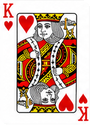
AK often continues with two overcards, and if a King pairs without making a better hand, it can still pay AA.
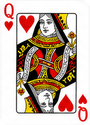
AQ often continues with two overcards, and if a Queen pairs without making a better hand, it can still pay AA.
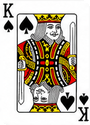
KK is a premium pair that can still pay several bets when it remains in the pot. AA is the stronger value hand in that exchange.
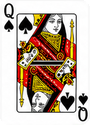
QQ can continue with an overpair and still pay AA before the action becomes too strong.
Weak against
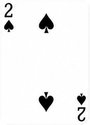
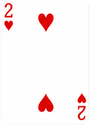 22
2222 can call to set-mine. When it hits a concealed set, AA can lose a very large pot before the danger is obvious.
Flop classes
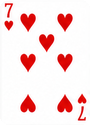
On A♣ 7♥ 2♦, AA flops top set and can use large value sizes when worse Ax and pairs continue.
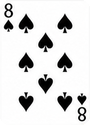
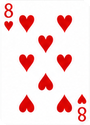
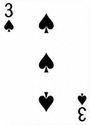
On 8♠ 8♥ 3♠, AA is an overpair to the board, not a set. It can value bet, but 8x and flush draws limit how freely it can inflate the pot.
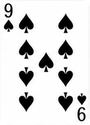
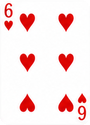
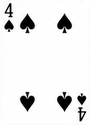
On 9♣ 6♦ 4♠, AA remains an overpair while 87, 75, sets, and pair-plus-draw hands have a direct draw or useful pair equity.
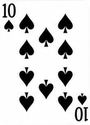
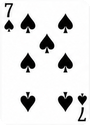
On T♠ 7♠ 4♠, AA is an overpair facing a made flush when the opponent holds two spades. A spade blocker and the action affect whether betting or checking is best.
Strategic notes
- 4-bet for value against almost every 3-bet range. The size should leave worse pairs and bluffs enough room to continue.
- Calling can be useful deep when the 3-bettor has many hands that would fold to a 4-bet but will keep betting after a call.
- On shallow stacks, raising simplifies the decision and prevents suited hands from realizing their draw equity cheaply.
- Continue aggressively against most 4-bet ranges and effective stack depths.
- Deep calling can protect a calling range when the opponent still has bluffs and worse value hands, but it should have a postflop plan.
- On an Ace-high, monotone, or highly connected flop, reassess the board before building the biggest possible pot with one pair.
- Value line: When an ace flops, AA has top set and can value bet against Ax, pairs, and draws, while still respecting the range and action.
- Control line: On T♠ 9♠ 8♦, AA is only an overpair and must account for straights, sets, two pair, and large draws before betting big.
- Common mistake: Treating AA as a hand that must stack off on every flop ignores the difference between an overpair and a set.