Strong suited broadway
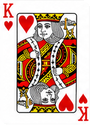
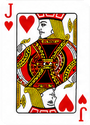
King-Jack Suited
KJs is a strong suited broadway with good playability, but it is not a premium hand. It can open, defend, and sometimes 3-bet in selected spots, yet it remains vulnerable to domination by AK, AQ, KQ, and premium pairs.
How to play KJs by position and stack size
| Recommended action | UTG8-max | UTG18-max | LJ6-max | HJ6-max | CO6-max | BTN6-max | SB6-max |
|---|---|---|---|---|---|---|---|
| 100bb+ | Open | Open | Open | Open | Open | Open | Open |
| 40-100bb | Open | Open | Open | Open | Open | Open | Open |
| 27-40bb | Open | Open | Open | Open | Open | Open | Limp |
| 20-26bb | Open | Open | Open | Open | Open | Open | Limp |
| 16-19bb | Open | Open | Open | Open | Open | Open | Limp |
| 11-15bb | Open | Jam | Open | Open | Open | Open | Jam |
| 7-10bb | Jam | Jam | Jam | Jam | Jam | Jam | Jam |
| 6bb- | Jam | Jam | Jam | Jam | Jam | Jam | Jam |
KJs combines king-high blockers with suited jack connectivity, so it can open earlier than KJo.
It can make a value-leaning or pressure 3-bet against wider ranges.
Its suitedness adds flush equity to the king-jack straight routes when stacks are deep enough.
KJs retains blocker and suited equity in an open-shove or reshove, subject to ICM.
Suitedness does not remove the risk of being dominated by AK, AQ, KQ, or premium pairs.
Strong against
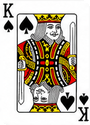
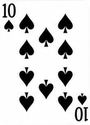
KTs shares the King but has the weaker kicker, making a dominated pair that can still pay KJs.
Weak against
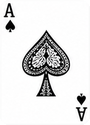 AKs
AKsAKs shares the King with the better kicker, so KJs can make a costly second-best pair.
Flop classes
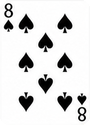
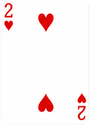
KJs makes king pair with a jack kicker on K♦ 8♠ 2♥. Its backdoor spade potential helps, but better Kx, two pair, and sets still cap the value line.
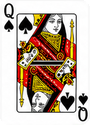
Q♠ J♦ T♠ gives KJs middle pair and a gutshot to a nine. When its suit matches the two spades, it also has a flush draw and can continue more often than KJo.
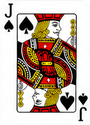
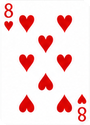
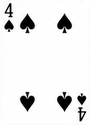
J♠ 8♦ 4♣ gives KJs top pair with a king kicker. The jack in hand blocks some top-pair combinations, while the suitedness preserves backdoor flush routes.
Strategic notes
- Call: Continue KJs more readily than KJo when the opener is wide and the price is good, especially in position where its suited draws realize better.
- Fold: Against tighter ranges, KJs should give up more often when its suited draws cannot realize enough equity.
- Fold: KJs normally folds to a 4-bet despite its suit, because the continuing range contains better kings and pairs.
- Continue only: A late-position exception needs a wide range and enough depth for its suited connectivity.
- Value: KJs can extract bets from K9 and worse king pairs when the board leaves those hands in range. Stronger kings still require caution.
- Control: On king-high or connected boards, protect the value of its kicker and draws rather than forcing a big pot.
- Mistake: KJs has extra flush equity, but a king pair is still not automatically a stack-off hand against a tight range with better Kx, two pair, or sets.