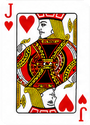
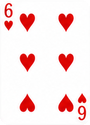
Weak suited Jack
Jack-Six Suited
J6s gains a real flush route, but the Six kicker still makes a Jack pair fragile and the J-to-6 gap gives little straight connectivity. Use it mainly for wide late-position opens or priced big-blind defenses. Depth helps the flush potential, position and the action preflop decide whether it is worth realizing.
How to play J6s by position and stack size
| Recommended action | UTG8-max | UTG18-max | LJ6-max | HJ6-max | CO6-max | BTN6-max | SB6-max |
|---|---|---|---|---|---|---|---|
| 100bb+ | Fold | Fold | Fold | Fold | Fold | Open | Limp |
| 40-100bb | Fold | Fold | Fold | Fold | Fold | Open | Limp |
| 27-40bb | Fold | Fold | Fold | Fold | Fold | Open | Limp |
| 20-26bb | Fold | Fold | Fold | Fold | Fold | Fold | Limp |
| 16-19bb | Fold | Fold | Fold | Fold | Fold | Fold | Limp |
| 11-15bb | Fold | Fold | Fold | Fold | Fold | Fold | Jam |
| 7-10bb | Fold | Fold | Fold | Fold | Fold | Fold | Jam |
| 6bb- | Fold | Fold | Fold | Fold | Fold | Jam | Jam |
A folded action and a suitable stack depth can justify the widest charted steals.
The suited blocker can help against a wide opener, but J6s is not a default pressure hand.
Out of position, the call needs enough effective depth for the flush draw to repay its cost.
At shallow depth, J6s loses much of its speculative value and relies on fold equity.
A weak kicker and a low, gapped side card make dominated top pairs common.
Strong against
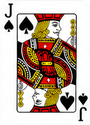
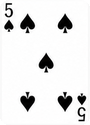
J5s shares the Jack but has the weaker kicker, making a dominated pair that can still pay J6s.
Weak against
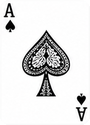 AJs
AJsAJs shares the Jack with the better kicker, so J6s can make a costly second-best pair.
Flop classes
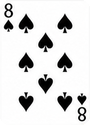
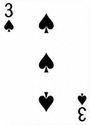
J♦ gives top pair, while 8♠ and 3♠ join the two spades in J6s to make a legal four-card flush draw. Continue, but do not treat the weak kicker as a value hand.
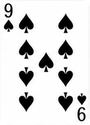
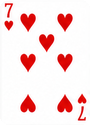
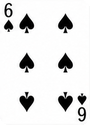
A pair of Sixes has little showdown value on 9-7-6. Continue with a direct draw, a good price, or a position advantage.
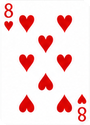
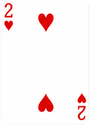
Without a flush draw or a concrete backdoor plan, check-fold to aggression.
Strategic notes
- Call selectively or fold: Continue only when position, price, and effective depth let the flush potential realize.
- Avoid automatic defense: A tight 3-bet range contains better Jx and higher suited flush draws that dominate many top-pair and flush outcomes.
- Separate the draw from the pair: A flush draw or a strong backdoor flush draw can continue, while a bare Jack pair usually wants pot control.
- Respect the kicker: J6s is often second-best when the Jack pairs against an early-position or 3-bet range.
- Keep connectivity precise: J6 does not flop an open-ended straight draw. It can develop runner-runner straights on specific boards, but the flush route is usually the main source of drawing equity.