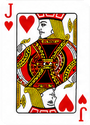
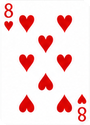
Speculative suited Jack
Jack-Eight Suited
J8s combines a useful Jack kicker, real flush potential, and better straight connectivity than J6s or J7s. It is still a speculative hand: late position and big-blind defense suit it best, while tight ranges and strong 3-bet action expose domination risks. Deep stacks increase the value of its draws.
How to play J8s by position and stack size
| Recommended action | UTG8-max | UTG18-max | LJ6-max | HJ6-max | CO6-max | BTN6-max | SB6-max |
|---|---|---|---|---|---|---|---|
| 100bb+ | Fold | Fold | Fold | Fold | Open | Open | Limp |
| 40-100bb | Fold | Fold | Fold | Open | Open | Open | Limp |
| 27-40bb | Fold | Fold | Fold | Fold | Open | Open | Limp |
| 20-26bb | Fold | Fold | Fold | Fold | Open | Open | Limp |
| 16-19bb | Fold | Fold | Fold | Fold | Fold | Open | Jam |
| 11-15bb | Fold | Fold | Fold | Fold | Jam | Jam | Jam |
| 7-10bb | Fold | Fold | Fold | Jam | Jam | Jam | Jam |
| 6bb- | Fold | Fold | Fold | Jam | Jam | Jam | Jam |
J8s can enter a wider open range when folded action and stack depth support post-flop play.
Use it as a charted bluff at a useful frequency, not as a default aggressive hand.
Depth helps realize both the flush and the straight routes.
At shallow stacks, fold equity matters more than implied odds and ICM can change the answer.
J8s can make strong draws, but a weak top pair does not justify a large pot against a strong range.
Strong against
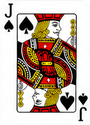
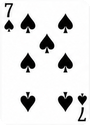
J7s shares the Jack but has the weaker kicker, making a dominated pair that can still pay J8s.
Weak against
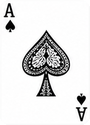 AJs
AJsAJs shares the Jack with the better kicker, so J8s can make a costly second-best pair.
Flop classes
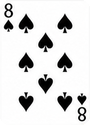
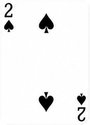
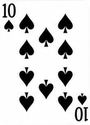
J♦ gives top pair, while 8♠ and 2♠ join the two spades in J8s to make a legal four-card flush draw. The draw adds equity, but better Jx still dominate the pair.
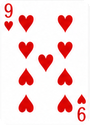
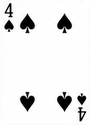
T♠ and 9♦ give J8s an open-ended straight draw, while J8s keeps backdoor flush potential in its suit. Continue according to price and position.
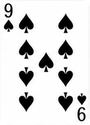
With no pair and no direct draw, J8s should often check and give up rather than bluff without a range or blocker reason.
Strategic notes
- Call: Continue in position when the price lets J8s realize its lower straight and flush draws.
- Fold: Against tight ranges or out of position, fold more often because better Jx and higher suited hands dominate too many pair outcomes.
- Fold: A standard 4-bet asks J8s to risk chips with a jack that is often dominated and a draw that cannot realize its price.
- Continue only: A blind-versus-blind exception still needs a very wide range and enough post-flop depth.
- Value the right top pairs: J8s can value-bet against weaker Jx, but it should control the pot when stronger Jx remain likely.
- Use exact draw labels: T-9-x can give an open-ended straight draw, and two board cards of the suit can create a four-card flush draw with J8s.
- Avoid automatic aggression: On dry boards, J8s's suitedness is not a reason to turn every miss or weak pair into a large bluff.